
For 21 men and women with early-stage Huntington’s disease, Irvine’s emerging status as a medical innovation hub couldn’t be more personal – and urgent.
That’s the number of patients expected to enroll in a UC Irvine trial of an experimental treatment for the hereditary disorder, which progressively kills brain cells. Huntington’s disease symptoms include involuntary, jerky movements; trouble walking, speaking or swallowing; and cognitive decline.
The researchers say their approach – injecting neural cells into patients’ brains – is just as hopeful as it is unprecedented.
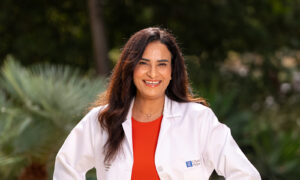
“We don’t know if it will cure the disease, but it’s not out of the question,” says neurologist Ravi Rajmohan, who is leading the trial.
The UC Irvine study is one of a growing list of local achievements raising the city’s profile as a medical hub. That list includes medtech and pharmaceutical breakthroughs and infrastructure buildouts such as the opening of the $1.2 billion, state-of-the-art Sun Family Campus of Hoag Hospital last month, with its specialty centers for women’s health, surgical innovation, cancer and digestive health.
Planning for progress
The city’s status is a result of wise decisions by early master planners.
Irvine began with the sale of 1,000 acres of the historic Irvine Ranch to the University of California system, which chose the site for a new campus. Today UC Irvine is one of America’s leading research universities.
In 1960, Irvine Company retained renowned architect William Pereira and his firm to master plan a new community around the university. The blueprint dedicated large areas to employment districts – office parks, research space and light-industrial areas – separate from residential villages. Irvine Company Chairman Donald Bren would later recall that Pereira aimed to develop “clean industry,” rather than smokestacks.
Over the years, planners also paid special attention to local healthcare facilities. In 1983, Irvine Company donated 15 acres for the city’s first community hospital, Irvine Medical Center, at the corner of Alton Parkway and Sand Canyon Avenue, while unveiling the design for a 400-acre medical corridor to surround it. Irvine’s hospitals – including Hoag, UCI Health and City of Hope – have seen a $4 billion investment come to fruition with new facilities opening in the past 10 months.
A steady stream of talented UC Irvine graduates and infrastructure development has bolstered the city’s large biotech and medtech firms and ambitious startups. The trends contribute to Orange County’s leadership in four sectors especially: ophthalmology, cardiac care, neurovascular treatments and aesthetics, says Bill Carpou, CEO of Octane, a leading life sciences accelerator based in Newport Beach. “Irvine is an important part of a broader ecosystem that is one of the top ecosystems in the world in those four areas,” he says.
Irvine’s innovation groundwork also encompasses UC Irvine’s Beall Applied Innovation, which helps researchers turn inventions into companies, and University Lab Partners, a nonprofit life-sciences incubator offering young biotech and medtech firms shared labs, specialized equipment, mentors and investors.
Medical pioneers
Giant companies that settled in Irvine even before the city incorporated have been a wellspring of innovation. Local leaders take pride in being home to Edwards Lifesciences, a more-than-$50-billion, publicly traded leader in cardiovascular devices, with 5,000 local employees. Miles “Lowell” Edwards, the company’s founder, made history in 1960 when his partner, cardiac surgeon Albert Starr, achieved the first long-term successful artificial mitral valve replacement in a human patient, with a valve the two designed. In 1971, Edwards moved his company, then called Edwards Laboratories, to Irvine.
In one of its many medtech advances since then, Edwards Lifesciences won the first U.S. Food and Drug Administration approval in 2011 for a catheter-delivered aortic valve, helping usher in a new era in which some patients could have a failing heart valve replaced without open-heart surgery.
Another large firm, Allergan, opened in Irvine in 1966. After acquiring Botox in 1991, Allergan helped turn a limited treatment for eye-muscle disorders into a cosmetic phenomenon, developing it for wrinkles and winning FDA approval for Botox Cosmetic in 2002. Allergan was acquired by AbbVie in 2020.
Irvine’s Masimo makes devices that test blood-oxygen levels, including pulse oximeters that clip to a patient’s finger. In 2005, Masimo invented what it described as the world’s first device capable of measuring carbon monoxide in the blood without having to draw blood. Earlier this year, Danaher acquired the company.
Irvine-based startup Inari Medical – sold to Stryker in 2025 – pioneered FlowTriever, a catheter system to treat pulmonary embolism by mechanically removing dangerous clots without clot-busting drugs, which can cause serious bleeding.
Research breakthroughs
UC Irvine faculty have racked up several medical firsts.
In 2009, a spinal-cord-injury therapy, developed by UC Irvine neuroscientists Hans Keirstead and Gabriel Nistor, became the first human embryonic-stem-cell-based treatment cleared by the FDA for clinical testing in people.
In a different sort of groundbreaking effort, last year UCI Health opened the nation’s first all-electric acute care hospital – a major step forward in efforts to reduce air pollution and fossil fuel emissions. General Services Director Joe Brothman says he has since become an ambassador for the project, sharing information with interested colleagues throughout the world.
UC Irvine’s novel treatment to slow the progression of Huntington’s disease comes from years of research by a team led by Leslie M. Thompson, a Donald Bren Professor of psychiatry and human behavior. The trial, funded by the California Institute of Regenerative Medicine, will evaluate the safety of delivering neural stem cells directly to the brain. Three patients have been treated with no serious adverse effects, according to Rajmohan.
The neurologist Steven Goldman, a pioneering stem-cell researcher at the universities of Rochester and Copenhagen, whose lab develops cell-based treatments for diseases, including Huntington’s, confirmed that Thompson’s research outcome is “first out of the block.” Goldman says, “She’s really a superstar, and Irvine should be very proud to have her.”
Irvine has long had “a strong name in neurobiology,” Goldman says, going back to pathbreaking research by Carl Cotman, who founded the UCI Institute for Brain Aging and Dementia (now UCI MIND) and directed it for two decades. In the mid-1990s, Cotman’s UCI laboratory was the first to show that exercise boosts expression of BDNF, a protein involved in cell growth in the brain.
It all contributes to Irvine’s stature as one of the healthiest cities in the nation, with consistently high marks for fitness, safety and lifestyle. The recent investment ensures healthy habits for decades to come.