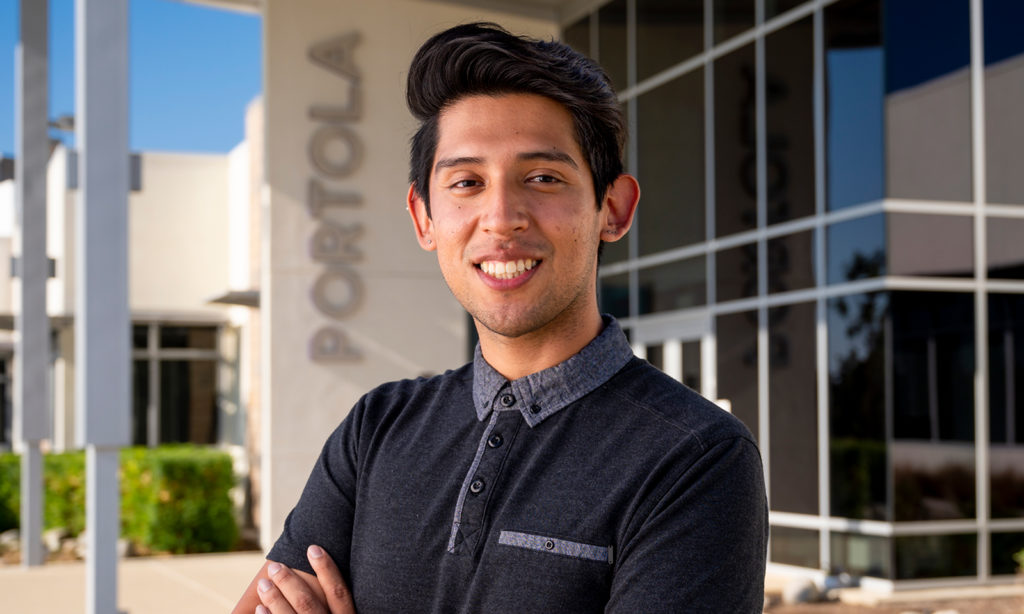
Portola High physics teacher Christian Quinteros plans to bring an ancient sea creature into his classroom this month – one he’s sure will make a lasting impression on his students.
He first saw it off the rocky coast of Maine last summer while taking part in a 10-week project funded by the National Science Foundation.
“When I first heard the word hagfish, I didn’t know what it was,” says Quinteros, who spent his summer studying these eel-like creatures with Chapman University biological sciences professor Douglas Fudge. “But this was, honestly, one of the greatest opportunities I have had as a teacher.”
Quinteros was one of just two Orange County teachers selected for the program that is designed to immerse teachers in scientific research so they can, in turn, show students how science is actually done.
“This gave me the opportunity to go out in the field and study in depth what we teach with textbooks,” Quinteros says. “That is, observing and collecting data, and experiencing the scientific process.”
Portola High Principal John Pehrson praises Quinteros’ initiative, which he says embodies a school culture aimed at bringing “relevancy and real-world application into the classroom.”
“He is truly one of the finest young educators I’ve ever worked with.” – Dr. Tara Barnhart, Chapman University
In just five years since its opening, Portola High has sent graduates to top-ranked colleges, including Stanford, Harvard and Yale.
One reason is the school’s implementation of Next Generation Science Standards, so far adopted by 20 states. The standards are designed to equip students with the ability to think critically, analyze information and solve complex problems – skills in great demand throughout today’s workplace.
Another is teachers like Quinteros, who are always bettering themselves.
“He is truly one of the finest young educators I’ve ever worked with,” says Dr. Tara Barnhart, a Chapman University professor involved in the recent project. “His mind is always pursuing connections and finding ways to maintain a rigorous learning environment for his students.”
Quinteros says his goal is to produce phenomena in the classroom for students to observe, question and form a hypothesis about.
Because of its name and looks, he adds, a hagfish creates a natural level of interest.
“It leaves an almost unforgettable experience,” Quinteros says. “And that’s what we want to have in the classroom – something that the students will remember.”