Mobility in Irvine is about more than getting from point A to point B; it is about the integration of neighborhoods, retail centers, schools, parks and primary business hubs. Central to this success is a unique hierarchy of roads envisioned in the original Master Plan.
While most communities rely on a traditional grid, Irvine was designed with a specific three-tier system: high-capacity freeways that connect the city to the region, wide arterial parkways such as Irvine Center Drive and Jamboree Road that carry drivers across town, and local roads designed for low speeds and less volume. This design eliminates cut-through traffic in residential areas.
To keep this system functioning as intended, the city – along with regional partners such as Caltrans, Orange County Transportation Authority and The Toll Roads – has focused on a series of freeway improvements.
Safety in the spotlight
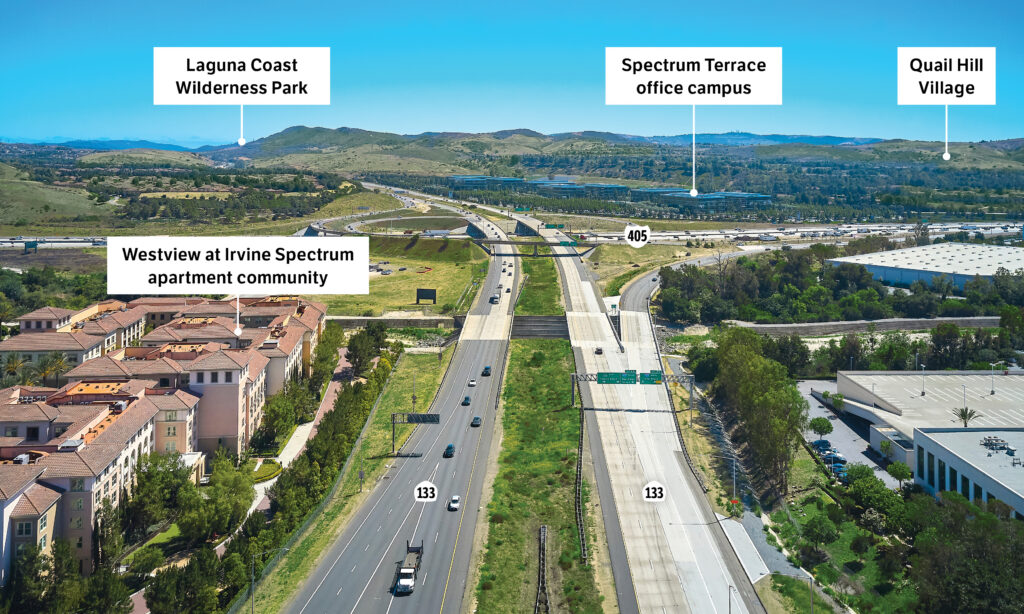
A recent milestone for local drivers is the newly optimized connector from the northbound 133 to the northbound 405. The project, a collaboration between Caltrans and the city of Irvine, fundamentally redesigned the approach by adding a dedicated exit lane and significantly upgraded lighting. The high-visibility lighting ensures that the merge is safer and more intuitive during evening commutes, while the extra lane has improved the morning merge for residents transitioning onto the 405.
Modernizing Jeffrey Road
The momentum continues at the Jeffrey Road and University Drive interchanges with the 405. In addition to widening the off-ramps to address backups, new lanes have been added to the on-ramps, providing a much-needed acceleration buffer for drivers merging onto the northbound 405. Crews cleared roadside landscaping and cut back brush to allow for crucial slope stabilization and improved sight lines.
Enhancing gateways
Infrastructure upgrades also targeted the Spectrum Center Drive off-ramps from the 405, where crews implemented paving and drainage improvements to keep the heavy influx of retail and commercial traffic flowing smoothly into Irvine’s premier shopping destination.
Meanwhile, the southbound 405 off-ramp to Sand Canyon Avenue has undergone targeted widening and concrete paving as part of the Revive the 405 initiative. By expanding the ramp at the Sand Canyon intersection to create dedicated turn lanes, the project eliminates a long-standing bottleneck where right-turning drivers were trapped behind vehicles waiting to turn left.
“This is going to be an amazing change,” says Quail Hill resident Ania Pfeil. “With the new hospitals on Sand Canyon, more vehicles are turning left, and you’d have to wait for them and the signal when turning right into the community.” She also says that getting onto the 405 northbound is being improved, with an additional lane making the morning merge easier. “Construction is taking a while, but when it’s all done it will be a massive improvement.”
Going forward
Future projects that have been approved or are in the planning stages include new ramps from the 133 toll road to Great Park Boulevard, the rerouting of Marine Avenue from Great Park to Sand Canyon Avenue and a new entrance and exit from the south side of Great Park to Barranca Parkway, near City of Hope. All of these will improve access to Great Park and help alleviate congestion at the existing Marine Avenue and Sand Canyon Avenue intersection.
Upcoming designs like Caltrans’ I-5 Managed Lanes project, which will convert the traditional HOV lanes between Red Hill Avenue and the L.A. County line into high-efficiency Express Lanes while adding an additional Express Lane in select sections, help bring a remarkable milestone into focus. Within a five- to 10-year window, virtually every major freeway lane passing through, feeding into or bordering Irvine will have been modernized, expanded or improved.
Designed for the future
These projects serve as a reminder that construction is a sign of a city maturing. Long-term master planning ensured that critical land corridors were set aside decades ago for these expansions, allowing the city to scale its infrastructure seamlessly without encountering the landlocked bottlenecks seen in older neighborhoods.
For a community where some residents can go days without driving on a freeway while others use the freeways daily, these improvements ensure that whether one is on a neighborhood loop or a regional commute, the journey remains as well planned as the city itself.